
How to Find a Trustworthy Contractor in South Jersey by County

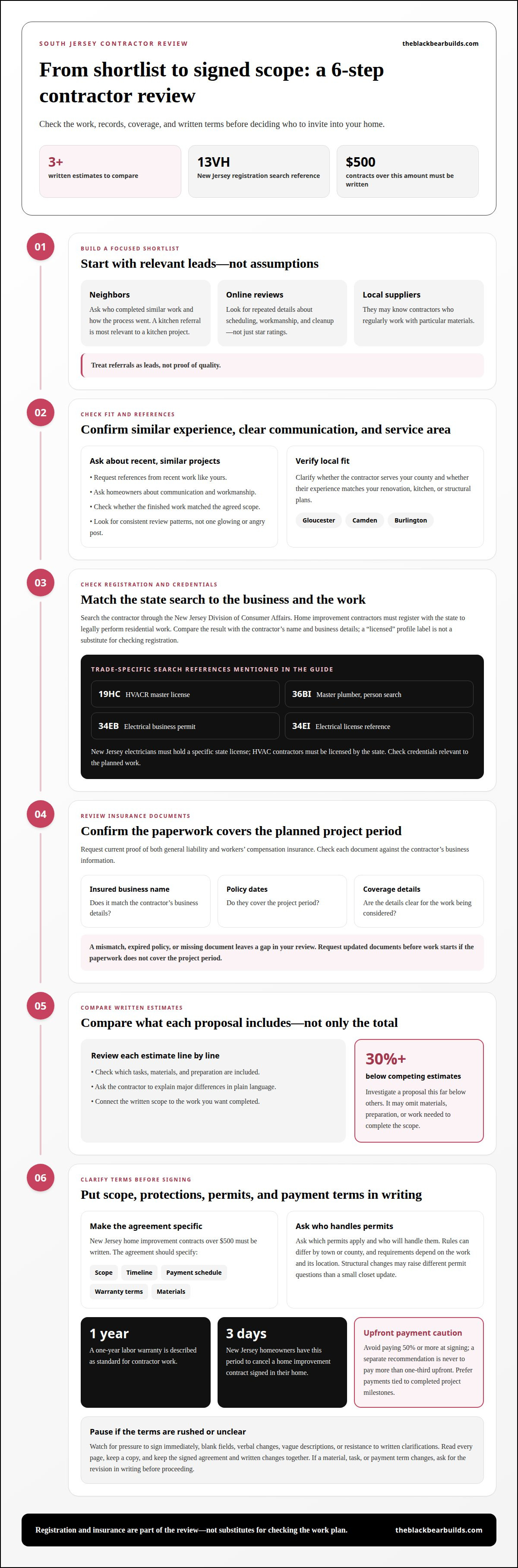
A confident promise is only a starting point; a careful review of records, insurance, and written estimates gives you a firmer basis for choosing. Finding a trustworthy contractor in South Jersey starts with confirming New Jersey registration, reviewing proof of general liability and workers’ compensation insurance, and comparing at least three written estimates.
It’s reasonable to want more than a polished proposal before inviting a contractor into your home. Look for clear project details, consistent answers, and references for similar recent work. Be cautious of pressure to decide quickly, vague agreements, or requests for a large upfront payment.
This guide explains how to check registration and insurance, compare estimates and references, and recognize common warning signs. It also covers how to assess whether a contractor’s project experience and service area fit your home in South Jersey, including Gloucester, Camden, and Burlington counties.
Table of Contents
Ready to Find Your South Jersey Pro?
A practical approach to finding a trustworthy contractor in South Jersey begins with a focused shortlist and careful comparisons. Use referrals, reviews, and local suppliers to identify candidates, then consider project experience and communication.
Find Contractors Through Referrals, Reviews, and SuppliersAsk neighbors who completed similar work which contractor they hired and how the process went. A kitchen renovation referral may be more useful for your kitchen project than a recommendation based on unrelated work. Check online reviews for repeated details about scheduling, workmanship, and cleanup, not just star ratings. Local suppliers may also know contractors who regularly work with particular materials. Treat referrals as leads, not proof of quality.
Check Client References and CommunicationLook for specific examples in customer reviews, such as how a contractor handled a delay or explained a change. Seek consistent patterns across reviews rather than relying on one glowing or angry post. Ask for references from recent, similar projects and ask homeowners about communication, workmanship, and whether the finished work matched the agreed scope. A “licensed” label in a profile doesn’t replace checking the applicable New Jersey registration.Before work begins, put the project terms in writing. New Jersey home improvement contracts over $500 must be written, and should specify the scope, timeline, payment schedule, warranty terms, and materials.
Clarify permits and contract protections. Ask which permits apply to your project and who will handle them. Permit rules can differ by town or county in South Jersey, so requirements depend on the work and its location. For example, a project involving structural changes may raise different permit questions than a small closet update.Finding a trustworthy contractor in South Jersey also means understanding the contract’s protections before signing. A one-year labor warranty is described as standard for contractor work. New Jersey homeowners have three days to cancel a home improvement contract signed in their home. Keep the signed agreement and any written changes together, so the scope and terms remain clear as work progresses.
Verifying New Jersey contractor registration and insurance
Use New Jersey’s registration search, any trade-specific licensing checks relevant to the work, and insurance documents to review a contractor’s registration and coverage. Tie each check to the work planned for your home.
Search the contractor’s registration through the New Jersey Division of Consumer Affairs. New Jersey home improvement contractors must register with the state to legally perform residential work. Look for the registration reference 13VH, then compare the result with the contractor’s name and business details. The state search can also list contractors classified in a selected trade, helping homeowners focus their review.
Match any trade-specific credential to the work involved. New Jersey electricians must hold a specific state license, and HVAC contractors must be licensed by the state. For HVACR, the 19HC master license is the relevant search reference. For plumbing, 36BI identifies a master plumber in a person search. Electrical contractor checks may involve the 34EB business permit reference and 34EI license reference.
Request current proof of general liability and workers’ compensation insurance. Check the insured business name, policy dates, and coverage details against the contractor’s business information. A mismatch, expired policy, or missing document leaves a gap in your review. Ask for updated documents before work starts if the paperwork doesn’t cover the project period.
Consider registration and insurance alongside the contractor’s reputation, not as substitutes for reviewing the work plan. A valid registration doesn’t show how carefully a crew protects a finished room or communicates about changes. For an insurance-related construction project, keep documentation organized with the scope and written communications. Explore emergency insurance work as a related construction service.
Contractor red flags
Set an upfront payment limit before agreeing to a project schedule. Avoid paying a contractor 50% or more at signing; a separate recommendation is never to pay more than one-third upfront. A request beyond that threshold deserves careful scrutiny. Ask for a schedule tied to completed project milestones, rather than dates alone. For example, connect payments to clearly described stages, so you can see how each payment relates to progress.
Investigate an estimate that is 30% or more below competing estimates. A low total may omit materials, preparation, or work needed to complete the agreed scope. Compare the written descriptions line by line, not just the final figures. Ask which tasks and materials each estimate includes. If a contractor cannot explain a major difference in plain language, pause before accepting the proposal.
Watch for pressure to sign before you can review the terms. Claims such as “the offer ends today” can rush decisions about scope, payment, and liability. Take time to read every page and keep a copy of the signed agreement. Blank fields, verbal changes, and unclear descriptions are reasons to request revisions before signing. A clear record helps both sides understand what the project covers.
Pay attention to how a contractor responds when you raise a concern. Repeatedly changing explanations about the work, dismissing questions about liability, or resisting written clarifications can make responsibilities harder to understand. Keep a dated record of proposals and changes. If a material, task, or payment term changes, ask for the revision in writing before proceeding. A consistent explanation is more useful than an urgent promise to start.
Gloucester, Camden, and Burlington County service area
Assess service coverage using your project’s town and work type. South Jersey includes seven counties: Atlantic, Burlington, Camden, Cape May, Cumberland, Gloucester, and Salem.
Start with the exact municipality, not just the county. Gloucester, Camden, and Burlington each include distinct towns, so a broad county label may not tell you whether a contractor covers your address. Note the project location and describe the work, such as a full renovation, addition, or kitchen update. This gives you a clear basis for comparing coverage.
Separate county coverage from project fit. A contractor may work in a county but focus on different project types or scales. A structural addition, for example, involves different planning than a custom closet. Match the contractor’s stated services to your scope, and consider whether the project requires coordinated work across several rooms.
Factor local permit rules into your planning. New Jersey permit requirements can differ by town or county, so identify the municipality where construction will take place. Structural changes may raise different permit questions than interior finish work. Keep the location and scope in view when reviewing the proposed schedule and responsibilities.
Use county names carefully in online searches and directories. Contractor listings may organize coverage by county, trade, or business type. A Camden County listing, for instance, is a starting point, not proof that a particular town or project fits the contractor’s work. Review the stated service area and project examples to assess the match.
Before choosing, align three details: the property’s town, the work required, and the contractor’s stated coverage. This prevents a county-wide label from obscuring practical differences between locations. For a home renovation, addition, or kitchen project in Gloucester, Camden, or Burlington County, discuss your South Jersey project and its location as you plan the next step.
Black Bear Construction
Black Bear Construction is a fit for projects that call for careful planning and skilled residential construction. Its services include full home renovations, additions and structural work, luxury seamless-flow kitchens, and custom closets and laundry niches. These offerings suit homeowners planning a major transformation, a structural change, or a specialized interior project.
Before discussing the work, clarify your project scope, material preferences, and priorities. A well-defined brief makes it easier to consider how each part should come together, from layout and function to the finished space.
If your project fits these services, contact Black Bear Construction to discuss your plans and request a free quote.
Make Your Next Project Step With Confidence
A good next step in finding a trustworthy contractor in South Jersey is to turn your priorities into a clear project brief. Note what you want to change, how the space should function, and which decisions matter most. This gives the first conversation a practical focus and helps connect your plans with the right construction work.
Black Bear Construction offers full home renovations, additions and structural work, and luxury seamless-flow kitchens. These services can support a broader home transformation, a structural change, or a carefully planned kitchen layout. Share the goals behind your project so the discussion can start with what matters in your home.
Contact Black Bear Construction today to discuss your plans. A thoughtful project begins with a clear conversation and a shared understanding of the space you want to create. Take that next step when you’re ready to move your plans forward.
Frequently Asked Questions
Do contractors need to be licensed in New Jersey?
New Jersey home improvement contractors must be registered with the state to legally perform residential work, while certain trades require separate licenses. Electricians and HVAC contractors, for example, must hold state licenses. Registration and trade licensing are separate checks, so match the credential to the work involved. For a renovation that includes electrical or HVAC work, confirm that the appropriate trade professional is licensed.
How Do You Compare Contractor Estimates?
Compare what each estimate includes, not just the total. Check whether proposals describe the same rooms, materials, preparation, and finish expectations. One kitchen estimate, for example, may include cabinetry installation but omit related finish work. Ask for unclear items to be explained in writing, then compare how each proposal addresses changes. This makes differences visible before you choose a scope that fits your priorities.
How Do You Protect Yourself During a Renovation?
Keep a written record from planning through completion. Save the signed agreement, revisions, payment records, and messages together. Photograph existing rooms before work begins, including surfaces near the renovation area, and keep copies of decisions about materials or design changes. If the project affects multiple spaces, label records by room. A clear, dated record helps resolve misunderstandings about what changed and when.
How many estimates should I get for a home improvement project?
Get at least three written estimates before hiring. Use the same project description for each, such as the rooms involved, intended materials, and work you expect completed. Consistent details make the proposals easier to compare. If one estimate differs substantially, identify which tasks or materials explain the gap rather than choosing based on its total alone. Keep the estimates with your project documents for reference.
How much should I pay a contractor upfront?
Avoid paying more than one-third of the project’s total cost upfront. Before making an initial payment, make sure the written agreement explains the work and payment schedule. Later payments should correspond to defined progress, so each amount has a clear connection to completed work. Be cautious if a contractor requests half or more before starting, or pressures you to pay before reviewing the terms.
Need a Referral to a Trusted Contractor?
For residential projects in South Jersey, assess whether the contractor’s work fits your needs and location. Black Bear Construction serves homeowners across South Jersey, including Haddonfield, Collingswood, Haddon Heights, Woodbury, Mullica Hill, Medford Township, Marlton, Voorhees, Mount Laurel, Berlin, and South Hampton. Its services include renovations, additions and structural work, and luxury seamless-flow kitchens. If your project aligns with these services, contact Black Bear Construction to discuss your plans.


Comments